Forget the European Championship currently held in France or the
upcoming Olympic Games in Rio. Doping scandals are making the headlines more than
ever in 2016. From tennis star Sharapova receiving a two-year ban for her use of
the controversial ‘meldonium’, to the seemingly never-ending doping scandals in
athletics. As if this was not enough, a new chapter
was added on 14 June to one of the most infamous and obscure doping sagas in
history: the Operación Puerto.
The special criminal appeal chamber,
the Audiencia Provincial, has held that the more than 200 blood bags of
professional athletes that have been at the center of the investigations since
2006 can be delivered to the relevant sporting authorities, such as the Spanish
Anti-Doping Agency (AEPSAD), WADA, the UCI and the Italian Olympic Committee
(CONI). In other words, there is now a good chance that the identities of the
involved athletes might eventually be revealed.
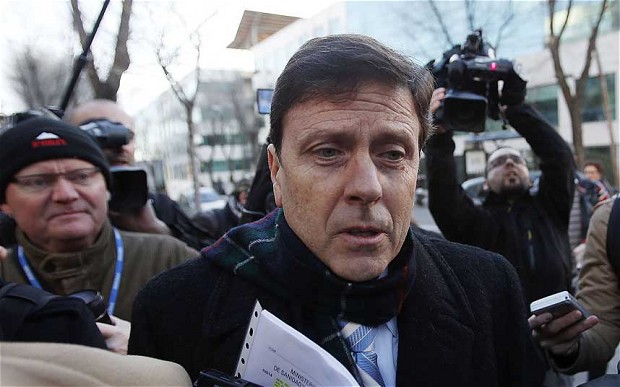
Source: http://www.telegraph.co.uk/sport/othersports/cycling/9834122/Operation-Puerto-doctor-Eufemiano-Fuentes-treated-tennis-players-athletes-footballers-and-a-boxer.html
This case note will analyze the court’s ruling and summarize its most
important findings. Given the amount of time passed since the scandal first
came to light (2004), the blog will commence with a short background summary of
the relevant facts. More...
Editor's note: Marine Montejo is a graduate from the College of Europe in Bruges and is currently an intern at the ASSER International Sports Law Centre.
On 3 June 2016, the Landgericht München (“Munich
Regional Court”) ordered temporary injunctions against the International Basketball Federation (“FIBA”)
and FIBA Europe, prohibiting them from sanctioning clubs who want to
participate in competitions organized by Euroleague Commercial Assets (“ECA”).
The reasoning of the Court is based on breaches of German and EU competition
law provisions. FIBA and FIBA Europe are, according to the judge, abusing their
dominant position by excluding or threatening to exclude national teams from
their international competitions because of the participation of their clubs in
the Euroleague. This decision is the first judicial step taken in the ongoing
legal battle between FIBA and ECA over the organization of European basketball competitions.
This judgment raises several interesting points with
regard to how the national judge deals with the alleged abuse of a dominant
position by European and international federations. A few questions arise
regarding the competence of the Munich Regional Court that may be interesting
to first look at in the wake of an appeal before examining the substance of the
case. More...
Editor’s note: Kester Mekenkamp is an LL.M. student in European Law at Leiden University and an intern at the ASSER International Sports Law Centre.
On 17 February 2016,
the Landesarbeitsgericht Rheinland-Pfalz
delivered its highly anticipated decision in the appeal
proceedings between German goalkeeper Heinz Müller and his former employer,
German Bundesliga club Mainz 05.[1]
The main legal debate revolved around the question (in general terms) whether
the use of a fixed term contract in professional football is compatible with
German and EU law.
In first instance (see
our earlier blog posts, here and here), the Arbeitsgericht Mainz had ruled that the
‘objective reasons’ provided in Section 14 (1) of the German
Part-time and Fixed-term Employment Act (Gesetz über Teilzeitarbeit und befristete
Arbeitsverträge, “TzBfG”), the national law implementing EU
Directive 1999/70/EC on fixed-term work, were not applicable
to the contract between Müller and Mainz 05 and therefore could not justify the
definite nature of that contract.[2]
In its assessment the court devoted special attention to the objective reason
relating to the nature of the work, declining justifications based thereupon.[3]
Tension rose and the verdict was soon labelled to be able to have Bosman-like
implications, if held up by higher courts.[4]
More...
On 18 May 2016, the day the first part
of this blog was published, the Commission said in response
to the Hungarian MEP Péter Niedermüller’s question, that it
had “not specifically monitored the tax relief (…) but would consider doing so.
The Commission cannot prejudge the steps that it might take following such
monitoring. However, the Commission thanks (Niedermüller) for drawing its
attention to the report of Transparency International.”
With the actual implementation in Hungary appearing to
deviate from the original objectives and conditions of the aid scheme, as discussed
in part 1 of this blog, a possible monitoring exercise by the Commission of the
Hungarian tax benefit scheme seems appropriate. The question remains, however,
whether the Commission follows up on the intent of monitoring, or whether the
intent should be regarded as empty words. This second part of the blog will outline
the rules on reviewing and monitoring (existing) aid, both substantively and
procedurally. It will determine,
inter
alia, whether the State aid rules impose an obligation upon the Commission
to act and, if so, in what way. More...
Yesterday, 18 May 2016, the licensing committee of the Dutch football
federation (KNVB) announced its decision to sanction FC Twente with relegation to
the Netherland’s second (and lowest) professional league. The press release also
included a link to a document outlining the reasons underlying the
decision. For those following the saga surrounding Dutch football club FC
Twente, an unconditional sanction by the licensing committee appeared to be
only a matter of time. Yet, it is the sanction itself, as well as its
reasoning, that will be the primary focus of this short blog.More...
The tax
benefit scheme in the Hungarian sport sector decision of 9 November 2011 marked a turning point as
regards the Commission’s decisional practice in the field of State aid and
sport. Between this date and early 2014, the Commission reached a total of ten decisions
on State aid to sport infrastructure and opened four formal investigations into
alleged State aid to professional football clubs like Real Madrid
and Valencia CF.[1]
As a result of the experience gained from the decision making, it was decided
to include a Section on State aid to sport infrastructure in the 2014 General Block Exemption Regulation. Moreover, many people, including myself, held that
Commission scrutiny in this sector would serve to achieve better accountability
and transparency in sport governance.[2]
Yet, a recent report by
Transparency International (TI), published in October 2015, raises questions about the efficiency of State aid enforcement in
the sport sector. The report analyzes the results and effects of the Hungarian tax benefit scheme and
concludes that:
“(T)he sports
financing system suffers from transparency issues and corruption risks. (…) The
lack of transparency poses a serious risk of collusion between politics and
business which leads to opaque lobbying. This might be a reason for the
disproportionateness found in the distribution of the subsidies, which is most
apparent in the case of (football) and (the football club) Felcsút.”[3]
In other words, according to TI, selective economic
advantages from public resources are being granted to professional football
clubs, irrespective of the tax benefit scheme greenlighted by the Commission
or, in fact, because of the tax
benefit scheme. More...
Editor’s note: This report
compiles all relevant news, events and materials on International and European
Sports Law based on the daily coverage provided on our twitter feed @Sportslaw_asser. You are invited
to complete this survey via the comments section below, feel free to add links
to important cases, documents and articles we might have overlooked.
The Headlines
This month saw the conflict between FIBA Europe
and the Euroleague (more precisely its private club-supported organizing body,
Euroleague Commercial Assets or ‘ECA’) becoming further entrenched. This
dispute commenced with FIBA creating a rival Basketball Champions League, starting from the 2016-2017 season with the hope to reinstate their
hold over the organization of European championships. The ECA, a private body
that oversees the Euroleague and Eurocup, not only decided to maintain its
competitions but also announced it would reduce them to a closed, franchise-based league following a
joint-venture with IMG. In retaliation, FIBA Europe suspended fourteen
federations of its competition (with the support of FIBA) due to their support for the Euroleague project.More...
Editor’s note: Marine Montejo
is a graduate from the College of Europe in Bruges and is currently an Intern
at the ASSER International Sports Law Centre.
In its decisions regarding the joint selling of football media rights (UEFA, Bundesliga, FA Premier
league), the European Commission insisted that premium media
rights must be sold through a non-discriminatory and transparent tender
procedure, in several packages and for a limited period of time in order to
reduce foreclosure effects in the downstream market. These remedies ensure that
broadcasters are able to compete for rights that carry high audiences and, for
pay TV, a stable number of subscriptions. In line with these precedents, national
competition authorities have tried to ensure compliance with remedy packages.
The tipping point here appears to be the premium qualification of sport rights
on the upstream market of commercialization of sport TV rights.
This begs the question: which sport TV rights must be
considered premium? More...
Update: On 14 April footballleaks released a series of documents concerning Sporting de Gijón. Therefore, I have updated this blog on 19 April to take into account the new information provided.
Doyen Sports’ TPO (or TPI) model has been touted as a “viable alternative source of finance much needed by the large majority
of football clubs in Europe". These are the
words of Doyen’s CEO, Nélio Lucas, during a debate on (the prohibition of) TPO
held at the European Parliament in Brussels last January. During that same
debate, La Liga’s president, Javier
Tebas, contended that professional football clubs, as private undertakings,
should have the right to obtain funding by private investors to, among other
reasons, “pay off the club’s debts or to compete better”. Indeed, defendants
of the TPO model continuously argue that third party investors, such as Doyen, only
have the clubs’ best interests in mind, being the only ones capable and willing
to prevent professional football clubs from going bankrupt. This claim constitutes
an important argument for the defendants of the TPO model, such as La Liga and La Liga Portuguesa, who have jointly submitted a complaint in front of the
European Commission against FIFA’s ban of the practice.[1]
The eruption of footballleaks provided the essential material necessary to test this claim. It allows
us to better analyse and understand the functioning of third party investment and
the consequences for clubs who use these services. The leaked contracts between
Doyen and, for example, FC Twente, showed that the club’s short term financial
boost came at the expense of its long-term financial stability. If a club is
incapable of transferring players for at least the minimum price set in Doyen’s
contracts, it will find itself in a financially more precarious situation than
before signing the Economic Rights Participation Agreement (ERPA). TPO might
have made FC Twente more competitive in the short run, in the long run it
pushed the club (very) close to bankruptcy.
More than four months after its launch, footballleaks continues to publish documents from the football
world, most notably Doyen’s ERPAs involving Spanish clubs.More...
Editor’s note: This report
compiles all relevant news, events and materials on International and European
Sports Law based on the daily coverage provided on our twitter feed @Sportslaw_asser. You are invited to complete this survey via the comments section
below, feel free to add links to important cases, documents and articles we
might have overlooked.
Marine Montejo is a graduate from the College of
Europe in Bruges and is currently an Intern at the ASSER International Sports
Law Centre.
The Headlines
The Belgian Court of Appeal released its
judgment this month regarding Doyen’s legal battle against the FIFA TPO ban.
The Appeal Court confirmed the first instance decision and ruled out any provisional
measures to block the ban’s implementation (for an in depth review, see
our blog post). More importantly, the Court
reaffirmed that Swiss based sport federations are liable in front of EU Members’
States courts when EU competition law is involved. That means the next
important step for this legal battle is whether or not the European Commission
is going to open a formal proceeding (Doyen
already lodged a complaint) to assess the compatibility,
and more importantly, the proportionality of the TPO ban with EU law. Only a
preliminary ruling by the CJEU could hasten the decision if one of the European
national courts, hearing a case brought by Doyen (France or Belgium), decided
to refer a preliminary question.More...